Sunday, July 26, 2026

Robert Irwin ‘death-rolled’ by 14-foot crocodile named after Jimmy Fallon

by


µRobert Irwin has spent his life face-to-face with deadly animals – but after he was “death-rolled” by “Jimmy Fallon,” the young conservationist admitted he wasn’t sure he’d survive.

Robert Irwin was only 2 years old when the world lost the beloved “Crocodile Hunter” after a short-tail stingray barb pierced his chest during filming near the Great Barrier Reef.

Steve, 44, had built a global following through his fearless wildlife work, energetic personality, and deep passion for conservation, turning dangerous animal encounters into unforgettable lessons about protecting nature.

Nearly two decades later, many fans believe they see that same energy and spirit living on through Robert.

Now 22, Robert has grown into one of Australia’s most recognizable conservationists, regularly working with crocodiles, snakes, and other dangerous animals at the Australia Zoo alongside his 27-year-old sister, Bindi and mother Terri, 61.

Whether he’s appearing in documentaries, sharing wildlife education online, or telling stories during television interviews, viewers often point out how that he’s “so much like his dad” – not just physically, but in his humor, “energy,” and natural storytelling ability.

That resemblance was especially clear during Robert’s appearance on The Tonight Show Starring Jimmy Fallon on May 5, 2026, when he shared a story that sounded like something straight out of Steve Irwin’s own adventures.

Robert revealed that a massive crocodile he named after Fallon years ago nearly crushed him during a dangerous conservation task.

The crocodile, now measuring around 14 feet long, has grown into what Robert described as a “boss croc” since first receiving the talk show host’s name as a baby.“He’s not a baby anymore,” Robert joked while speaking with Fallon. “I named this crocodile Jimmy Fallon, like, years ago, and he’s now what we call a boss croc. He’s huge.”

While the audience laughed along with him, Robert explained that the work itself is very real – and very dangerous.

Researchers at Australia Zoo regularly handle crocodiles as part of conservation efforts designed to better understand and protect the species in the wild. According to Robert, the unusual hands-on approach traces back to techniques his father helped develop years earlier.

“Because we research crocodiles in the wild to, like, better conserve them, right?” Robert said. “So, the way you do that – my dad came up with this – is you actually have to jump on them.”

“So I jumped on the back of Jimmy Fallon and he…And get this. The little…he death rolled me,” he told the host as the audience erupted into laughter over his delivery.

But behind the humor was a genuinely frightening moment.

After leaping onto the crocodile’s back, Robert said the reptile reacted immediately, violently twisting its body in a dangerous combat maneuver known as a death roll.

“I jumped onto him. I kid you not, 14-foot of crocodile, big croc, death-rolls me,” he recalled. “So, I’m stuck underneath him with my arm hanging out.”

The force of the spin trapped him beneath the crocodile’s enormous weight.

“I’ve got like probably, I don’t know, maybe 700 pounds on top of me,” he continued. “And I’m just like, ‘What do I do?’ And luckily he rolled back the other way, and I was fine. But he’s a goer.”

The story quickly caught attention online, with many fans commenting on how naturally Robert carries forward the legacy his father left behind.

From his comfort around dangerous animals to the way he mixes humor with education, viewers saw echoes of the senior wildlife warrior throughout the interview.“He’s got so much of his dad’s energy it’s crazy. Absolutely wonderful,” shared one netizen in the comment section of the Jimmy Fallon YouTube clip.

“Gosh he is his pops man,” said a second user, while another added, “It’s almost like he’s Steve reincarnated.”

Through his conservation work, humor, and fearless approach to wildlife education, Robert has stepped naturally into the legacy his father created while building a path entirely his own.

What do you think of Robert Irwin carrying on his father’s incredible legacy? Please let us know your thoughts and then share this story so we can hear from others!

Taylor Swift admits that she tested positive for…See more

by


Taylor Swift’s Honest Revelation: A Pause in the Eras Tour and the Power of Transparency
Few artists in modern music have captured the world’s attention quite like Taylor Swift. Over the years, she has transformed from a teenage country singer into one of the most influential entertainers on the planet. Her record-breaking albums, sold-out stadium tours, and deeply personal songwriting have created a connection with fans that goes far beyond music. Yet one of the most remarkable aspects of her success is not simply her talent—it is her willingness to be honest.

When Taylor Swift recently opened up about the need to pause and reflect during her monumental Eras Tour journey, fans around the world responded with understanding, admiration, and support. Her revelation highlighted something that is often overlooked in today’s fast-paced culture: even the most successful people need moments of rest, reflection, and transparency.

In an era where celebrities are often expected to appear flawless and unstoppable, Swift’s openness served as a powerful reminder that authenticity remains one of the strongest qualities a public figure can possess.

The Phenomenon of the Eras Tour
The Eras Tour quickly became more than just a concert series. It evolved into a cultural event that united millions of fans across continents. Each performance celebrated different chapters of Swift’s musical career, allowing audiences to relive the songs, memories, and emotions that defined various periods of their own lives.

From her country roots to her pop dominance and indie-folk explorations, every era represented growth and transformation. Fans dressed in outfits inspired by specific albums, exchanged friendship bracelets, and turned each concert into a shared celebration of music and community.

The scale of the tour was unprecedented. Stadiums sold out within minutes. Cities experienced economic boosts from the influx of visitors. Social media platforms became flooded with videos, reactions, and emotional stories from attendees.

However, behind the dazzling lights, elaborate stage designs, and marathon-length performances was an artist carrying an enormous workload. Delivering such a massive production night after night required extraordinary physical stamina, mental focus, and emotional energy.

The Reality Behind the Spotlight
The entertainment industry often presents success as glamorous and effortless. Audiences see the final performance but rarely witness the countless hours of preparation that make it possible.

For a tour of the Eras Tour’s magnitude, the demands are immense. Travel schedules can be exhausting. Rehearsals are rigorous. Performers must maintain vocal health, physical fitness, and emotional resilience while constantly being in the public eye.

Even for someone as experienced as Taylor Swift, maintaining that level of performance over an extended period is challenging.

When she acknowledged the need to pause and reflect, she offered fans a rare glimpse behind the curtain. Rather than pretending that everything was easy, she chose honesty.

That honesty resonated because it reflected a universal truth: everyone has limits.

No matter how successful, talented, or determined a person may be, there comes a time when rest becomes necessary rather than optional.

Why Transparency Matters
Transparency has become increasingly valuable in a world dominated by carefully curated social media images and polished public personas.People often feel pressure to present only the highlights of their lives. Challenges, struggles, and moments of uncertainty are frequently hidden from public view.

Taylor Swift’s willingness to speak openly stands in contrast to that trend.

Transparency creates trust. When public figures acknowledge their challenges, they become more relatable. Audiences recognize that success does not eliminate stress, fatigue, or vulnerability.

Instead of weakening a person’s image, honesty often strengthens it.

Fans appreciate authenticity because it reflects real life. They understand that growth involves setbacks, adjustments, and moments of reflection.

By sharing her experience, Swift reinforced the idea that being open about one’s needs is not a sign of weakness—it is a sign of self-awareness.

The Importance of Mental and Emotional Well-Being
One of the most significant lessons from Swift’s revelation is the importance of mental and emotional health.

For many years, discussions about mental well-being were often stigmatized. People felt pressure to keep pushing forward regardless of exhaustion or stress.

Today, however, there is growing recognition that mental health deserves the same attention as physical health.

High-pressure environments can affect anyone. Business leaders, students, athletes, parents, and entertainers all face moments when demands become overwhelming.

Ignoring those pressures rarely leads to positive outcomes. In many cases, pushing too hard can result in burnout, decreased performance, and emotional exhaustion.

Swift’s openness encourages a healthier perspective. Taking a pause does not mean giving up. It means recognizing when recovery is needed so that long-term success remains sustainable.

This message is particularly important for younger audiences who may feel constant pressure to achieve more, do more, and be more.

Sometimes the most productive decision is to rest.

Breaking the Myth of Perfection
One reason Taylor Swift’s comments generated such widespread discussion is that they challenged the myth of perfection.

Celebrities are often placed on pedestals. Their accomplishments can make them appear larger than life.

Yet perfection is an illusion.

Every person faces obstacles, doubts, and difficult moments. The difference is that public figures experience those challenges under intense scrutiny.

By acknowledging her need for reflection and balance, Swift reminded fans that imperfection is normal.

This message carries tremendous cultural significance.

Many people compare themselves to idealized images they encounter online. They see carefully edited photographs, professional achievements, and seemingly perfect lifestyles.

What they often do not see are the struggles behind those images.

Transparency helps bridge that gap. It allows people to understand that challenges are part of every journey.

Rather than striving for perfection, individuals can focus on growth, resilience, and authenticity.

The Strong Connection Between Swift and Her Fans
Taylor Swift has built one of the most loyal fan communities in the world. A major reason for that loyalty is her consistent effort to communicate directly and honestly with supporters.

Throughout her career, she has shared personal stories through her music. Songs about heartbreak, friendship, ambition, and self-discovery have allowed listeners to see themselves in her experiences.

That emotional connection extends beyond her lyrics.

When Swift speaks openly about challenges, fans often feel validated in their own experiences. They recognize emotions they have felt themselves.

This creates a relationship built on mutual understanding rather than celebrity worship.

Her transparency sends a powerful message: success does not require hiding your humanity.

In fact, embracing humanity may be one of the keys to meaningful success.A Lesson for the Entertainment Industry

Swift’s revelation also highlights a broader conversation within the entertainment industry.

For decades, performers were often expected to maintain relentless schedules regardless of personal well-being. Touring, recording, promotions, interviews, and public appearances could create enormous pressure.

Fortunately, attitudes are beginning to change.

Increasingly, artists are speaking openly about burnout, anxiety, mental health challenges, and the need for balance.

This shift benefits both performers and audiences.

Healthy artists are more likely to sustain long careers, produce meaningful work, and maintain positive relationships with fans.

The industry as a whole benefits when well-being becomes a priority rather than an afterthought.

Swift’s example contributes to that ongoing cultural change.

The Courage to Be Vulnerable
Vulnerability is often misunderstood.

Many people associate vulnerability with weakness. In reality, vulnerability requires courage.

It takes courage to admit limitations.

It takes courage to acknowledge uncertainty.

It takes courage to share personal experiences with millions of people.

Taylor Swift’s willingness to do so demonstrates confidence rather than insecurity.

She understands that authenticity fosters deeper connections than perfection ever could.

This lesson extends far beyond celebrity culture.

In workplaces, schools, friendships, and families, openness often strengthens relationships. People are more likely to trust those who are genuine about their experiences.

Vulnerability creates opportunities for empathy.

And empathy remains one of the most powerful forces in human connection.

What Fans Can Learn
The response to Swift’s honesty offers valuable lessons for fans and observers alike.

First, it reinforces the importance of listening to one’s body and mind. Ignoring signs of exhaustion rarely produces positive results.

Second, it demonstrates that taking breaks is healthy. Rest is not the opposite of productivity—it is part of productivity.

Third, it encourages individuals to be honest about their needs. Asking for support or creating space for recovery should never be viewed as failure.

Finally, it reminds people that success is not measured solely by achievements. True success includes maintaining well-being, meaningful relationships, and personal fulfillment.

These lessons apply regardless of profession, age, or background.

Everyone benefits from balance.

The Lasting Impact of Honest Conversations
Conversations about mental health, burnout, and self-care have become increasingly important in recent years.

Public figures play a unique role in shaping those discussions.

When someone with Taylor Swift’s global influence speaks openly about personal challenges, the impact extends far beyond entertainment headlines.

It helps normalize conversations that many people may otherwise avoid.

It encourages empathy.

It reduces stigma.

And it reminds audiences that seeking balance is both reasonable and necessary.

The significance of such conversations cannot be overstated.

In a culture that often glorifies constant productivity, messages about rest and reflection provide an essential counterbalance.

Looking AheadAs Taylor Swift continues her remarkable career, her legacy will likely encompass far more than album sales, awards, and record-breaking tours.

She has become a symbol of artistic evolution, resilience, and authentic self-expression.

Her willingness to share honest reflections about the realities of life on the road adds another important chapter to that legacy.

Fans admire her not only because of her achievements but also because of her humanity.

The Eras Tour will be remembered as one of the most successful concert tours in history. Yet the lessons surrounding it may prove equally meaningful.

Success and vulnerability can coexist.

Strength and honesty can coexist.

Ambition and self-care can coexist.

These truths are worth remembering long after the final encore.

Conclusion
Taylor Swift’s honest revelation about pausing and reflecting during the Eras Tour serves as a powerful reminder that transparency matters. In a world often dominated by carefully crafted images and unrealistic expectations, her openness stands out as both refreshing and inspiring.

By acknowledging the challenges that accompany extraordinary success, Swift demonstrated that self-awareness is not a weakness but a strength. Her message encourages fans to prioritize mental and emotional well-being, embrace authenticity, and recognize the value of rest.

The impact of her words extends beyond music. They speak to anyone who has ever felt overwhelmed, exhausted, or pressured to appear perfect.

Ultimately, Taylor Swift’s transparency offers an important lesson for all of us: life is not about maintaining an illusion of perfection. It is about being honest, taking care of ourselves, and continuing to grow through every chapter of our journey.

And sometimes, the strongest thing a person can do is simply pause, reflect, and move forward with renewed clarity.

Warning signs of high blood sugar?

by


Hyperglycemia, often associated with diabetes, presents warning signs well before diagnosis. Given a diet rich in processed foods, awareness and education are essential to detect and manage these indicators.

Please note that we do not provide medical advice. The content of our documents is purely informational. We strongly recommend that you consult a healthcare professional.

1. Excessive Urination
Hyperglycemia
Photo by Markus Spiske
Drinking too much water before bed can cause nighttime urination. However, high blood sugar can lead to urinary tract infections and an increased frequency of urination.

2. Blurred vision

Photo by Ksenia Chernaya

Temporary blurred vision is often due to hyperglycemia, not a need for glasses. Swelling of the lens caused by elevated glucose levels is likely the culprit.3. Difficulty concentrating

Photo by Thirdman.
A lack of insulin prevents the body from removing glucose from the blood, thus disrupting its functions. Fatigue, poor concentration, and dehydration can result from hyperglycemia, as the body tries to eliminate excess glucose through urine.

4. Dry mouth,
hyperglycemia.
Photo from Pixabay.

Elevated blood sugar levels cause dry mouth due to increased glucose in the blood and saliva.

5. Impotence,
Hyperglycemia.
Photo by JhoondiasThis problem, specific to men, results from inadequate regulation of blood sugar over the long term, leading to nerve and vascular damage.

6. Recurrent infections

Photo by Andrea Piacquadio

It is crucial to monitor for recurrent infections and dysfunctions of glands such as the thyroid, adrenal glands, and pituitary gland. Be vigilant for pancreatic diseases and significant elevations in blood sugar.

7. Slow-Healing Wounds
Hyperglycemia
Photo by MART PRODUCTION
Delayed healing of minor wounds may indicate hyperglycemia. Nerve damage and decreased blood flow hinder skin repair in the affected areas.

I just found this on my bed. It’s a little creepy. What is it?

by


I just found this on my bed. It’s a little creepy. What is it?

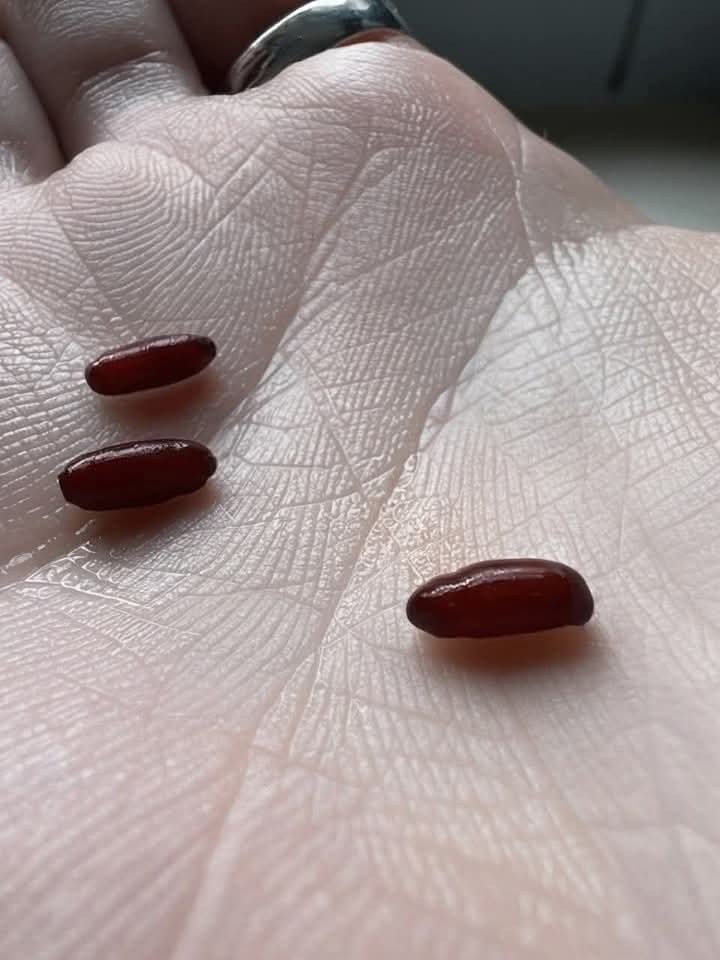
Imagine this: You enter your bedroom, ready to relax, and discover strange, reddish-brown objects on your bed. You pick them up: small, capsule-shaped, shiny, and unfamiliar. Immediately, a deep concern washes over you. Are they insect eggs? Strange seeds? Medication? Or something more serious?

1. Softgels (supplements or medications).
The shape and color are similar to conventional softgels, such as those containing fish oil, vitamin E, or krill oil. They dissolve easily and can be discreetly placed in the litter box. If you or someone you know takes supplements, you should check for compatible alternatives.2. Seeds.

This is less likely, but some seeds, like pomegranate or date seeds, may have a smooth, dark appearance. However, they usually have a more fibrous or opaque texture, as opposed to the shiny, jelly-like surface seen here.

3. Insect skin or feces?
This is a common concern: people think it might have something to do with insects. Fortunately, these objects do not resemble insect eggs, larvae, or feces. Most insect eggs are white or translucent and irregularly shaped. In this case, the objects are too uniform and shiny to be organic insect remains.

4. Candy
or edible beads. Although some candy or decorations may look similar, the likelihood of them suddenly appearing in a bed without food is very low.

That’s exactly what you see in the photo above. Three mysterious, reddish-brown objects were discovered in a person’s palm after they were found lying on a bed. Let’s look at some possible explanations for what these objects could be.


What Is the Piriformis Muscle?

The piriformis is a small muscle located deep in the buttock. It:

  • Starts on the front surface of the sacrum (base of the spine)
  • Passes through the greater sciatic foramen
  • Attaches to the greater trochanter of the femur (upper thigh bone)

Its main functions include:

  • External rotation of the hip
  • Hip abduction
  • Hip extension

Although small, the piriformis helps stabilize the hip during movement.


What Is Piriformis Syndrome?

Piriformis syndrome occurs when the piriformis muscle becomes tight, inflamed, or spasms, placing pressure on the sciatic nerve.

Because the sciatic nerve runs underneath—or sometimes through—the piriformis muscle, irritation of this muscle can compress the nerve.

This compression can cause symptoms similar to sciatica, including pain that travels from the buttock down the back of the leg.


What happens to your body if you don’t drink enough water

by


We often hear that we should drink more water, but between busy days, coffee after coffee and stress, we sometimes forget this simple gesture. However, water is not just a drink: it is an essential fuel for our body.

And if you knew everything your body signals when it runs out, you would never look at a glass of water the same way again…
Water, the treasure we don’t appreciate
Water, present in every cell of our body, plays an important role in digestion, circulation, regulating body temperature, and the proper functioning of organs… Without it, the overall balance is disrupted.

And yet, many people only drink when they are thirsty. But be careful: thirst is already a sign of mild dehydration. The secret is to be proactive. To do this, we need to be able to recognize the sometimes subtle signals that our body sends when there is no water.What happens to your body if you don’t drink enough water

Dark urine, which is a sign that your kidneys are giving you a warning

The first easy sign to notice is the color of your urine. If it’s clear, everything is fine. But if it turns dark yellow or even brown, it’s because your body is concentrating waste due to lack of water. Your kidneys are working harder, and this can be a problem in the long run.

Reduced toilet use

Do you spend long hours without going to the bathroom? This is a sign that you are not drinking enough. Normally, our body regularly eliminates the water it absorbs. If this is not the case, it tries to stop it as much as possible… which can interfere with the elimination of toxins.

 Fatigue and lack of energy

Do you feel exhausted when you wake up? Before you worry about iron deficiency or overload, just check… If you’re drinking enough. Dehydration slows down some brain functions and makes your body less responsive. The result: a less clear mind and persistent fatigue.

Craving for snacks, especially sweet foods

Do you always want to eat something? This may be because you confuse hunger with thirst. Sometimes your brain sends the same signal. Before you start snacking, start with a big glass of water. Sometimes it’s all your body needs.

Dry skin and lack of shineThe skin is one of the first organs to suffer from a lack of hydration. Tightness, dull skin, more visible fine wrinkles… Even the best creams are not enough without internal hydration. And it starts with a simple glass of water.

Frequent headaches

Recurring headaches may be your body’s signal to you to drink water. The brain, which is very sensitive to dehydration, responds quickly. Try this: The next time a migraine is approaching, slowly drink two glasses of water. You may be surprised at the relief.

Dry skin and lack of shine

The skin is one of the first organs to suffer from a lack of hydration. Tightness, dull skin, more visible fine wrinkles… Even the best creams are not enough without internal hydration. And it starts with a simple glass of water.

 Frequent headaches

Recurring headaches may be your body’s signal to you to drink more water. The brain, which is very sensitive to dehydration, responds quickly. Try this: The next time a migraine is approaching, slowly drink two glasses of water. You might be surprised at the relief you feel.
How can we drink more without thinking about it?
The good news is that you don’t have to count every glass. Here are some simple tips for incorporating water into your daily routine:

Keep your water bottle visible on your desk or in your bag.


 Start and end every meal with a glass of water

Add lemon, cucumber or mint for variety
Focus on water-rich foods (watermelon, cucumber, zucchini, etc.)
Use a reminder app if you tend to forget

What if the secret to your energy, clearer skin, and overall well-being was simply hidden in… A glass of water?

Many people cannot tell the difference between these things, but it is very important…Check the first comment 👇

by


In today’s fast-paced retail landscape, purchasing decisions are often made in a matter of seconds. Rather than studying detailed labels, many shoppers rely on visual signals such as container size, shape, and design to estimate value. While packaging may meet regulatory standards, the way a product appears on the shelf can strongly influence assumptions about…


In today’s fast-paced retail landscape, purchasing decisions are often made in a matter of seconds. Rather than studying detailed labels, many shoppers rely on visual signals such as container size, shape, and design to estimate value. While packaging may meet regulatory standards, the way a product appears on the shelf can strongly influence assumptions about quantity. A recent legal dispute in the spice market has brought renewed attention to the gap that can exist between what is disclosed on a label and what consumers believe they are buying.The disagreement centers on McCormick & Company and competitor Watkins Incorporated. Watkins alleges that McCormick reduced the net weight of certain black pepper products—from roughly eight ounces to six—while maintaining a similar container appearance. This practice is sometimes associated with “shrinkflation,”a term used to describe reductions in product quantity without significant visible changes to packaging. Watkins argues that consistent exterior design may lead customers to assume the contents remain the same, particularly when familiar products occupy the same shelf space.A key point in the case involves packaging transparency. Watkins typically uses clear containers, allowing buyers to see the volume of spices inside. In contrast, some McCormick products are sold in opaque tins, which prevent visual comparison of fill levels. Although labeling laws require accurate


 disclosure of net weight, critics suggest that consumers often rely more on visual cues than small-print measurements. The dispute raises questions about whether compliance alone is sufficient when presentation may shape purchasing assumptions.Beyond the legal arguments, the situation reflects a broader conversation about trust and clarity in consumer goods. As brands compete for loyalty, maintaining transparency—both technically and visually—becomes increasingly important. For shoppers, the lesson is practical: check the net weight and compare quantities rather than relying solely on packaging size. In an environment where small changes can affect overall value, informed decisions help ensure expectations align with reality

Can a woman live alone and cover her expenses without needing a man?

by


We often believe that intimacy is only physical. In reality, it is above all a matter of emotions, eye contact, trust and shared tenderness. Whether we are in a relationship or single, this need for human connection never completely disappears: it may be latent, but it is still there.

The answer is unique, like every life story. It’s not about weeks or months, but about inner balance, resilience, and the needs of the heart. Here are 10 truths that many women will relate to.

Yes, you can live without it… but not feel completely fulfilled.
A woman can live a full and successful life without physical contact or shared affection. But then that little “something” is missing: that gentle energy that comes from the connection, from the look or the hand resting on hers.

Emotional need is often the strongest.
The lack of gentle gestures can be tolerated, but the lack of emotional connection weighs much more heavily. The feeling of being seen, understood, loved: this nourishes a person’s spirit and self-esteem. Without it, loneliness gradually creeps in, even among others.

The body doesn’t forget

Even without a relationship, our bodies retain the memory of physical contact. A lack of attachment can manifest as nervousness, tension, or emotional exhaustion. The need for closeness simply remains latent.

Stress finds an open door

Moments of tenderness release feel-good hormones. Conversely, prolonged lack of comfort can increase stress and disrupt sleep. This is a human reaction, not a weakness.

The void is filled in other ways… but not completely.

Some women find refuge in work, reading, sports, or friendships… And that’s completely normal! These passions nourish the spirit, but they don’t completely replace the warmth of authentic human connection.

Self-esteem may fluctuate

When you go a long time without feeling loved or appreciated, you may begin to doubt your own worth. However, this lack says nothing about us: it does not reflect our beauty, our merits, or our ability to love.